How to Create HTTPS Local Domains for Your Projects
If you do any kind of local web development on Linux, you have almost certainly run into the browser warning that says “Your connection is not private” while testing your own app on localhost. It…

If you do any kind of local web development on Linux, you have almost certainly run into the browser warning that says “Your connection is not private” while testing your own app on localhost. It…

Deprecations and Stability Improvements Deprecations Due to the deprecation notice from the AWStats vendor, we will remove AWStats from the product distribution in Plesk Obsidian 18.0.79. We recommend switching to the alternative tool available in the product. Stability Improvements Across the…
Just what is DNS? Well, if you’ve ever had to set up a WiFi router or configure your local network, you’ll have seen Internet protocol (IP) addresses. To access the network admin panel, you type…

RAR files, a common compressed file format, are widely used to store and share large amounts of data efficiently. While Linux natively supports various compression formats like ZIP and TAR, RAR remains one of the…

Upgrading PHP on existing websites isn’t always straightforward. The benefits must be weighed against the risks and expenses of legacy applications, custom code, and third-party integrations. However, running end-of-life PHP versions without security patches exposes…
We all love listening to music and watching videos, whether it’s at the gym, at work, or relaxing at home, multimedia content is part of our daily life. Everyone has their own collection of favorite…

Whether you’re troubleshooting boot issues, preparing to format a drive, or setting up a new disk, knowing how to view disk and partition information is essential. In this guide, we will show how to list…
Have you ever looked at an Internet address and wondered, ‘what is .com?’. You may have heard talk of ‘.com businesses’ on the news or even ‘the .com crash’. In fact, if you spend any…
![How to Generate and Verify MD5 Checksums in Linux [5 Methods]](https://fastdomains.com.au/wp-content/uploads/2026/03/how-to-generate-and-verify-md5-checksums-in-linux-5-methods.png)
In this guide, we’ll explain what MD5 is, how to generate MD5 checksums for files, and how to verify file integrity using these checksums in Linux. When working with files on Linux, it’s important to…

In this article, you will discover 3 excellent break reminder apps for Linux that help prevent RSI, eye strain, and fatigue during long work hours. If you spend long hours working on your Linux system,…

In this article, you will learn how to copy, sync, backup, and transfer files locally and remotely using 16 useful rsync commands with practical examples. Rsync (Remote Sync) is the most commonly used command for…
What is a top-level domain? If you’re looking to develop an online presence, particularly for the first time, cutting through all the web-related jargon can sometimes be frustrating. What does it all mean? Well, you…
Blinded by science when it comes to securing a domain name? So many terms, so many options… It can all be overwhelming. Allow us to be your reliable compass as you navigate the choppy waters…
Next, why do you need a domain name? Domain names are important for a number of reasons, the main one being that they give customers a way to find you. If you have a business…
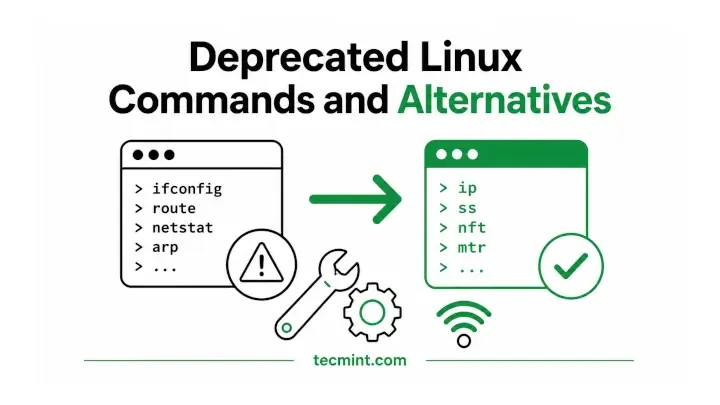
In this article, you will learn how to list, configure, enable, disable, and troubleshoot network interfaces in Linux using 15 useful ifconfig commands with practical examples. ifconfig (Interface Configuration is a utility for system/network administration…
As a Linux administrator, you must periodically check which files and folders are consuming more disk space, because it is very necessary to find unnecessary junk and free it up from your hard disk. In…

In this article, you will learn how to find which process or service is listening on a particular port in Linux using ss, netstat, lsof, and fuser commands. A port is a logical entity that…
Domain name extensions (TLDs) are the suffixes that follow domain names in web addresses. The most common is “.com”. Learn everything you need to know about them in this article, from what they are to…